
Ancient Tales
History & Legends
Ancient Tales of Devotion and Divinity
The Legend of Sage Agastya
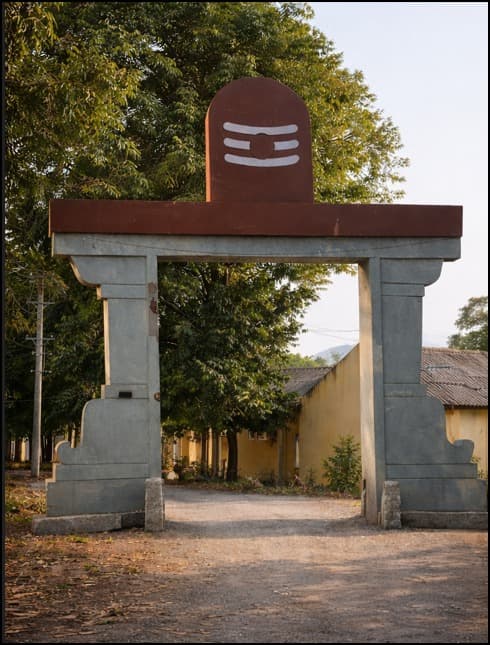
This sacred site was once the hermitage (ashrama) of the great Sage Agastya Maharshi, one of the revered Saptarishis. During his southward journey undertaken at the command of Lord Shiva to restore cosmic balance, Sage Agastya established his abode here and performed intense penance for the welfare of humanity.
According to sacred tradition, during the celestial wedding of Lord Shiva and Goddess Parvati at Mount Kailasa, the earth tilted northward due to the congregation of all celestial beings. To counterbalance the earth, Sage Agastya was sent southward.
On his journey, he encountered the Vindhya mountain range, which had grown excessively tall and obstructed the paths of the Sun and Moon. The sage commanded the mountains to bow down and remain so until his return. As Sage Agastya never returned, the Vindhyas remain humbled to this day.
By the divine grace of Lord Shiva, Sage Agastya was able to witness the celestial wedding at Kailasa from this very place.
The Sacred Swarnamukhi River
In those times, South India was largely arid and lacked sufficient water sources. Through his intense tapasya, Sage Agastya prayed to Lord Shiva and Goddess Ganga, resulting in the creation of several sacred rivers. One such river is the Swarnamukhi.
The Swarnamukhi River originates from the Mallepalli Hills near Adinepalli, about 30 km southwest of Tirupati on the Chittoor route. Flowing through the Hemanaga (Golden) Hills of Chandragiri, it acquired the name Swarnamukhi (Golden-faced).
Triveni Sangamam
Near the temple, the rivers Bhima and Kalyani merge with the Swarnamukhi, forming the sacred Triveni Sangamam, also known as Mukkoti Sthalam. This confluence is considered highly auspicious for holy baths, pitru tarpanam, abhishekam, and pradakshina.
After the advent of the Swarnamukhi River, this valley transformed into a serene and picturesque landscape, surrounded by the Mallepalli Hills to the south, Chandragiri Hills to the west, and the Seshachalam Hills to the north, with an open valley to the east.
Discovery of the Divine Lingam
One day, while bathing in the river, Sage Agastya discovered a Shiva Lingam submerged in the deep waters. He consecrated it on the riverbank and installed it as Sri Agastheeswara Swamy. Subsequently, a temple was constructed, and Sri Anandavalli Ammavaru was installed as the consort deity.
Temple Architecture
The temple architecture reflects classical Chola style with later Vijayanagara additions. A well-proportioned sanctum (garbhagriha), a three-tier Rajagopuram, spacious mandapams, and a beautifully carved 16-pillared mandapam stand as testimony to its historical and artistic heritage.
Pallava
Architectural Influence
Chola
Classical Style
Vijayanagara
Later Additions
Shaiva Kshetras Along Swarnamukhi
Along the course of the Swarnamukhi River flourished several ancient Shaiva Kshetras alongside renowned Vaishnava Kshetras such as Tirumala, Tirupati, Tiruchanoor, and Srinivasa Mangapuram.
Sri Agastheeswara Swamy
Thondavada
Sri Parasareeswara
Yogimallavaram
Sri Parasu Rameswara
Gudimallam
Sri Kapileswara
Kapila Teertham, Tirupati
Sri Kalahasteeswara
Srikalahasti
Festivals & Celebrations
Daily rituals are performed as per Shaiva Agama traditions. The following occasions are observed with great devotion:
- Maha Shivaratri
- Pradosham
- Karthika Masam
- Ugadi
- January 1st
- All Karthika Mondays
Rudrapadala Mukkoti (Annual Festival)
Celebrated for three days during Kartika Pournami:
Day 1: Annabhishekam and Annadanam
Day 2: Lingodbhava Abhishekam
Day 3: Kalyanam